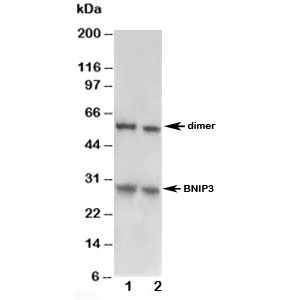
The Bcl-2 nineteen kilodalton interacting protein 3(BNIP3 or NIP3), is a hypoxia-inducible proapoptotic member of the Bcl-2 family that induces cell death by associating with the mitochondria. BNIP3, expressed in skeletal muscle and in the brain at low levels, is primarily localized to the nucleus of glial cells of the normal human brain, as well as in the malignant glioma cell line U251. BNIP3 expression in the cytoplasm increases and localizes with the mitochondria, contributing to induction of cell death. Cellular protein BNIP3 interacts with E1B-19K, BCL-2, BCL-xL, and EBV-BHRF1. BNIP3 contains Bcl-2 homology 3(BH3) domain and COOH-terminal transmembrane(TM) domain. The BH3 domain of BNIP3 mediates Bcl-2/Bcl-X(L) heterodimerization and confers pro-apoptotic activity; whereas the TM domain is critical for homodimerization, pro-apoptotic function, and mitochondrial targeting.
Formulation
0.5mg/ml if reconstituted with 0.2ml sterile DI water
Host
Rabbit
Immunogen Region
An amino acid sequence from the N-terminus of human BNIP3 (IYNGDMEKILLDAQHE) was used as the immunogen for this BNIP3 antibody (100% homologous in human, mouse and rat).
Isotype
IgG
Predicted Reactivity
Human, Mouse, Rat
Reactivity
Human, Mouse, Rat
Recombinant
No
Antigen
BNIP3
Uniprot
Q12983
Format
Antigen affinity purified
Purification
Antigen affinity
Storage
After reconstitution, the BNIP3 antibody can be stored for up to one month at 4°C. For long-term, aliquot and store at -20°C. Avoid repeated freezing and thawing.
 Loading ....