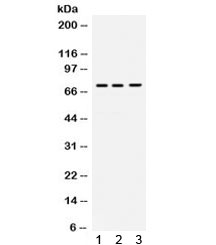
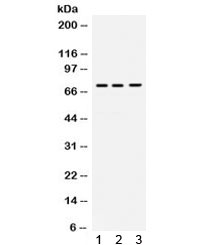
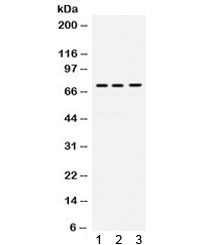
MAG (Myelin-associated glycoprotein), also known as SIGLEC4A, is a cell membrane glycoprotein that is a member of the SIGLEC family of proteins and is a functional ligand of the NOGO-66 receptor, NgR. It is thought to be involved in the process of myelination. Cleavage of GPI-linked proteins from axons protects growth cones from MAG-induced collapse, and dominant-negative NgR eliminates MAG inhibition of neurite outgrowth. MAG-resistant embryonic neurons were rendered MAG-sensitive by expression of NgR. MAG binds specifically to an NgR-expressing cell line in a GPI-dependent and sialic acid-independent manner. Experiments blocking NgR from interacting with MAG prevented inhibition of neurite outgrowth by MAG. In cultured human embryonic kidney (HEK) cells expressing the NOGO receptor, p75(NTR) was required for MAG-induced intracellular calcium elevation.
Formulation
0.5mg/ml if reconstituted with 0.2ml sterile DI water
Host
Rabbit
Immunogen Region
Amino acids EPPELDLSYSHSDLGKRPTKDSYTLTEELAEYAEIRVK of human MAG/SIGLEC4A were used as the immunogen for the Myelin-associated glycoprotein antibody.
Isotype
IgG
Predicted Reactivity
Human
Reactivity
Human
Recombinant
No
Antigen
MAG
Uniprot
P20916
Format
Antigen affinity purified
Purification
Antigen affinity
Storage
After reconstitution, the Myelin-associated glycoprotein antibody can be stored for up to one month at 4°C. For long-term, aliquot and store at -20°C. Avoid repeated freezing and thawing.
 Loading ....