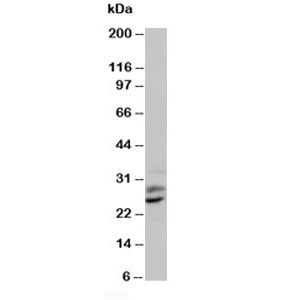
Placental growth factor(PGF, also known as PLGF) codes for an angiogenic factor expressed in placental tissue that is similar to vascular permeability factor/vascular endothelial growth factor(VPF/VEGF). It is a glycosylated dimeric secreted protein able to stimulate endothelial cell growth in vitro. PGF is located on chromosome 14 and has been conserved in evolution. It belongs to the family of vascular endothelial growth factors(VEGFs) and binds to the flt-1 VEGF receptor. PLGF-2, which is a PLGF isoform, binds neuropilin-1 and 2 in a heparin-dependent manner. PGF regulates inter- and intra molecular cross talk between the VEGF RTKs Flt1 and Flk1 and stimulates the phosphorylation of specific Flt1 tyrosine residues and the expression of distinct downstream target genes. Moreover, it plays an important role in pathological angiogenic events and with exerting its biological activities through binding to VEGFR1.
Formulation
0.5mg/ml if reconstituted with 0.2ml sterile DI water
Host
Rabbit
Immunogen Region
An amino acid sequence from the C-terminus of human PLGF (REKMKPERCGDAVPRR) was used as the immunogen for this PLGF antibody.
Isotype
IgG
Predicted Reactivity
Human
Reactivity
Human
Recombinant
No
Antigen
PLGF
Uniprot
P49763
Format
Antigen affinity purified
Purification
Antigen affinity
Storage
After reconstitution, the PLGF antibody can be stored for up to one month at 4°C. For long-term, aliquot and store at -20°C. Avoid repeated freezing and thawing.
 Loading ....