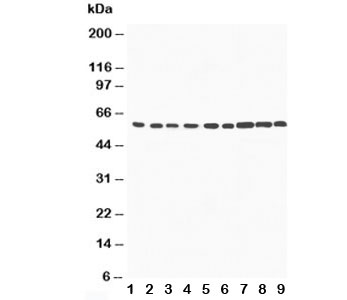
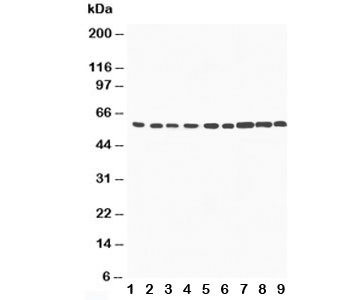
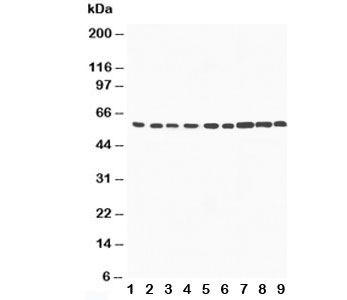
SMADs are proteins that modulate the activity of transforming growth factor beta ligands. The SMADs, often in complex with other SMADs/CoSMAD, act as transcription factors that regulate the expression of certain genes. Zhu, H et al concluded that targeted ubiquitination of SMADs may serve to control both embryonic development and a wide variety of cellular responses to TGF-beta signals. R-Smads or receptor regulated Smads are a class of proteins that include SMAD1, SMAD2, SMAD3, SMAD5, and SMAD8. In response to signals by the TGF-beta superfamily of ligands these proteins associate with receptor kinases and are phosphorylated at an SSXS motif at their extreme C-terminus. These proteins then typically bind to the common mediator Smad or co-SMAD SMAD4.
Formulation
0.5mg/ml if reconstituted with 0.2ml sterile DI water
Host
Rabbit
Immunogen Region
An amino acid sequence from the C-terminus of human SMAD1/2/3/5 (GPLQWLDKVLTQMGS) was used as the immunogen for this SMAD1/2/3/5 antibody (100% homologous human, mouse and rat).
Isotype
IgG
Predicted Reactivity
Human, Mouse, Rat
Reactivity
Human, Mouse, Rat
Recombinant
No
Antigen
SMAD1/2/3/5
Uniprot
Q15797
Format
Antigen affinity purified
Purification
Antigen affinity
Storage
After reconstitution, the SMAD 1/2/3/5 antibody can be stored for up to one month at 4°C. For long-term, aliquot and store at -20°C. Avoid repeated freezing and thawing.
 Loading ....