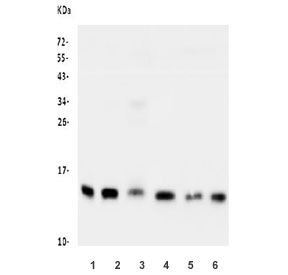
Cystatin C or cystatin 3, a protein encoded by the CST3 gene, is mainly used as a biomarker of kidney function. Recently, it has been studied for its role in predicting new-onset or deteriorating cardiovascular disease. It also seems to play a role in brain disorders involving amyloid, such as Alzheimer's disease. In humans, all cells with a nucleus (cell core containing the DNA) produce cystatin C as a chain of 120 amino acids. It is found in virtually all tissues and body fluids. It is a potent inhibitor of lysosomal proteinases (enzymes from a special subunit of the cell that break down proteins) and probably one of the most important extracellular inhibitors of cysteine proteases (it prevents the breakdown of proteins outside the cell by a specific type of protein degrading enzymes). Cystatin C belongs to the type 2 cystatin gene family.
Formulation
0.5mg/ml if reconstituted with 0.2ml sterile DI water
Host
Mouse
Immunogen Region
Amino acids K31-A146 from the human protein were used as the immunogen for the Cystatin C antibody.
Isotype
IgG2a
Predicted Reactivity
Human
Reactivity
Human
Recombinant
No
Antigen
Cystatin C
Uniprot
P01034
Clone No
4H8
Buffer
Lyophilized from 1X PBS with 2% Trehalose and 0.025% sodium azide
Format
Purified
Purification
Purified
Storage
After reconstitution, the Cystatin C antibody can be stored for up to one month at 4°C. For long-term, aliquot and store at -20°C. Avoid repeated freezing and thawing.
 Loading ....